Papers
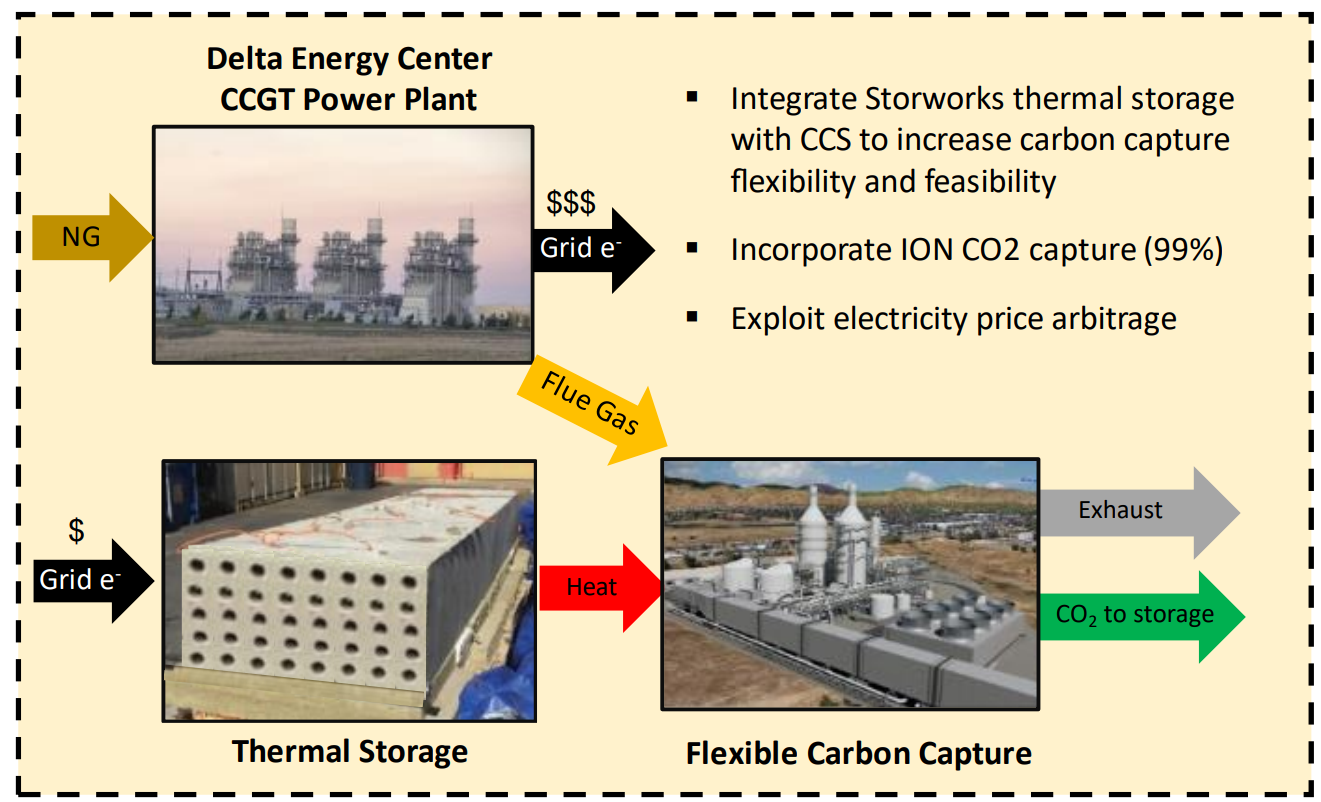
Engineering and Design of an Integrated Thermal Storage and Carbon Capture System on Calpine's Delta Energy Center
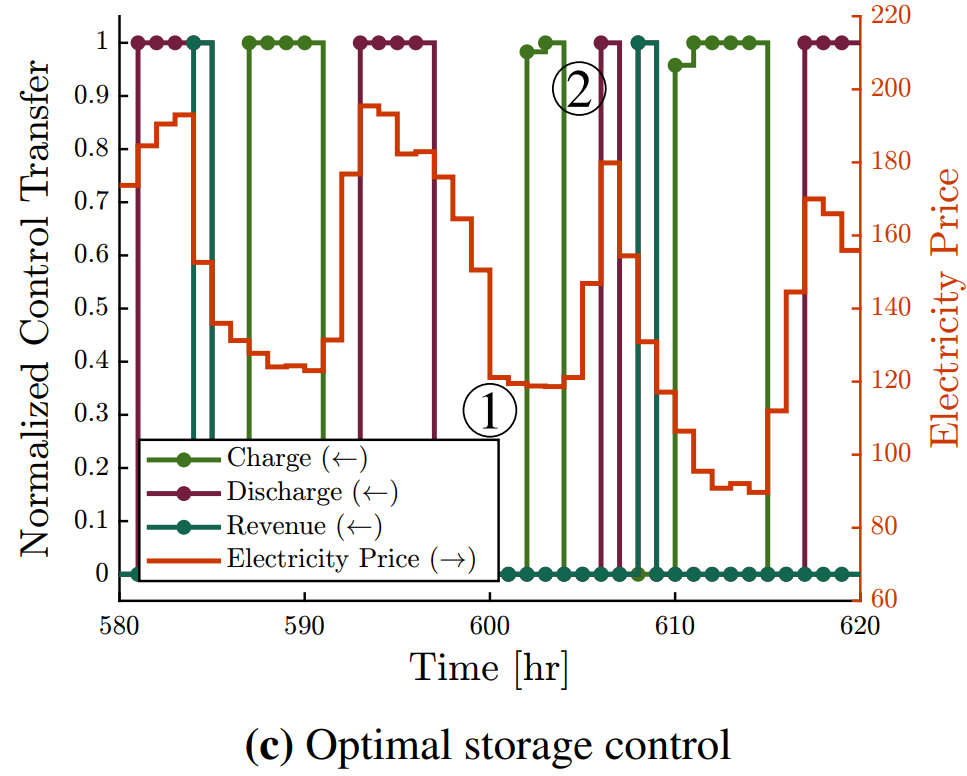
This work presents the engineering design and techno-economic evaluation of an integrated thermal energy storage and carbon capture system applied to a utility-scale combined-cycle power plant. The study analyzes dispatch strategies, storage sizing, and policy-driven economic feasibility. The United States electrical grid has begun transitioning towards lower-carbon energy sources increasingly through the implementation of variable renewable energy (VRE) sources such as solar and wind power. Fossil fuel power plants, such as combined-cycle gas turbines (CCGTs), have responded to this energy transition by increasing their responsiveness to electricity prices and becoming less base loaded. As carbon capture on these power plants becomes necessary to attain a net-zero electrical grid, further research is needed to determine how to most economically couple these carbon capture plants to the cycling fossil fuelpower plants in an electrical grid with high VRE penetration.
A General Framework for Supporting Economic Feasibility of Generator and Storage Energy Systems
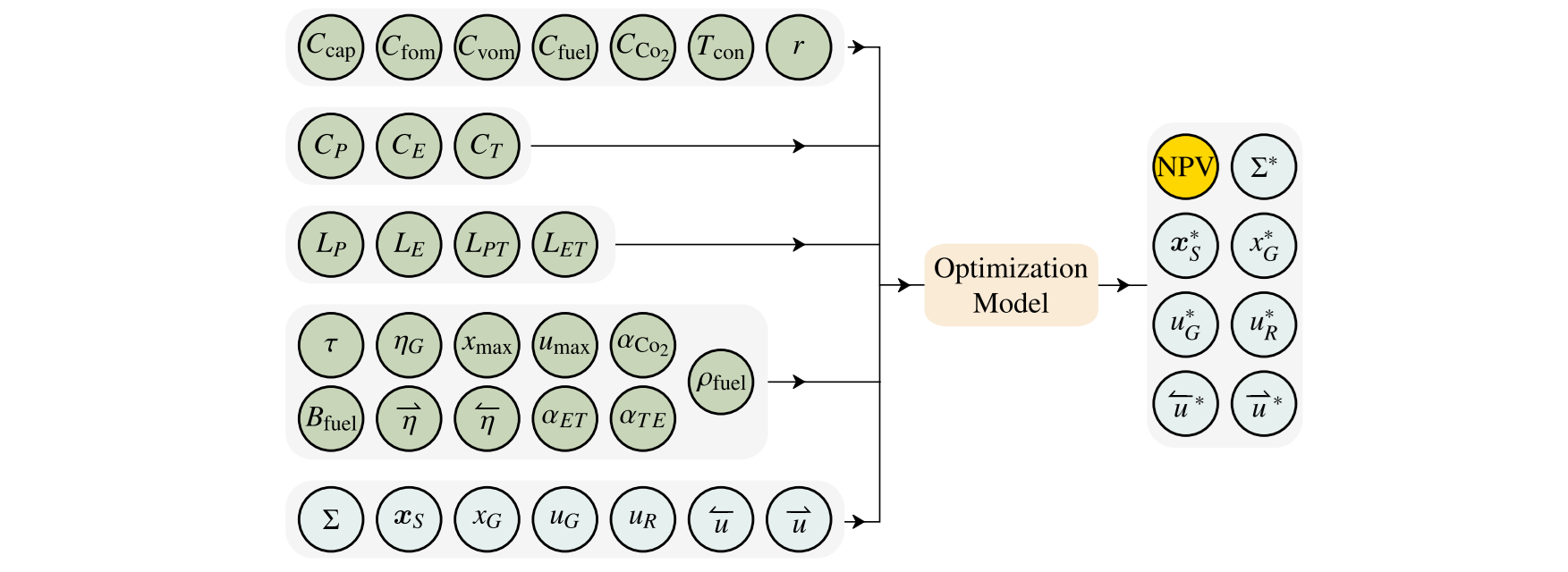
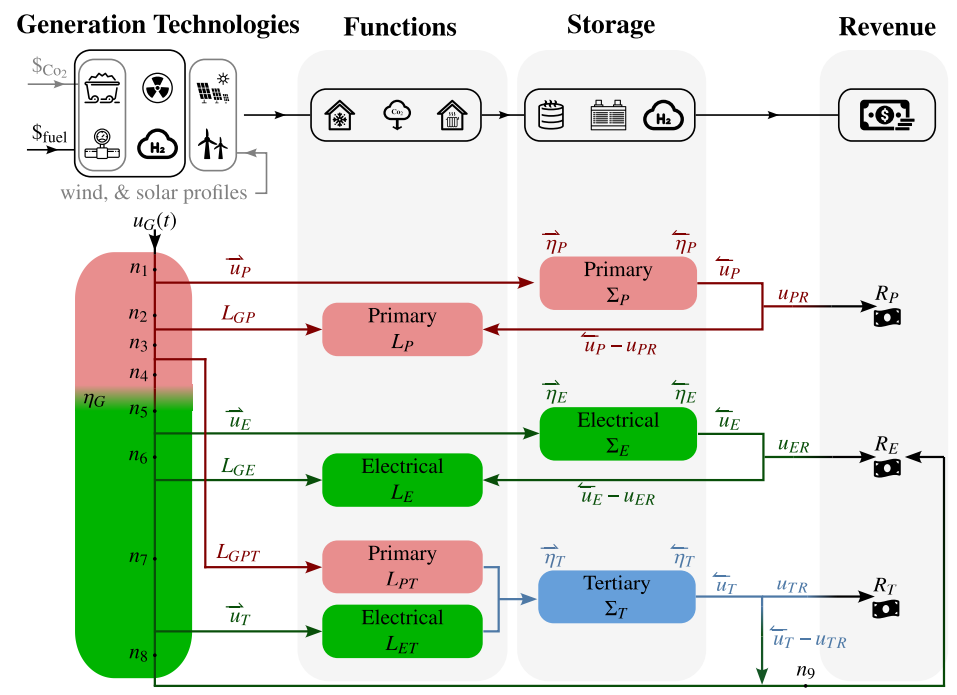
We propose a general optimization framework for evaluating the economic feasibility of generator and storage energy systems under uncertain market conditions. The framework enables long-horizon dispatch optimization and comparative system analysis. Integration of various electricity-generating technologies (such as natural gas, wind,nuclear, etc.) with storage systems (such as thermal, battery electric, hydrogen, etc.)has the potential to improve the economic competitiveness of modern energy systems.Driven by the need to efficiently assess the economic feasibility of various energy system configurations in early system concept development, this work outlines a versatile computational framework for assessing the net present value of variousintegrated storage technologies. The subsystems’ fundamental dynamics are defined,with a particular emphasis on balancing critical physical and economic domains to enable optimal decision-making in the context of capacity and dispatch optimization.
A General Framework for Supporting Economic Feasibility of Generator and Storage Energy Systems
This journal version extends the proposed framework with deeper theoretical grounding, expanded case studies, and long-term economic validation of integrated energy systems using dynamic optimization and control co-design. In its presented form, the frameworkformulates a linear dynamic optimization problem that can be efficiently solved througha direct transcription approach. The CCD optimization problem of an HES for 30 yearswith an hourly mesh can be solved in less than 1800 [s], depending on the case study. Three case studies focusing on natural gas with thermal storage and carbon capture, wind energy with battery storage, and nuclear with hydrogen are selected to demonstrate theframework’s capabilities in formulating a wide range of HES problems in the contextof CCD and dynamic optimization, highlighting its value in facilitating the techno-economicassessment of various HES configurations
Advanced capacity and dispatch co-design for the techno-economic optimization of integrated energy systems
This thesis explores the techno-economic performance of integrated energy systems using a linear optimization framework via direct transcription inside the DTQP environment. Three sample case studies — natural gas with thermal storage, wind power with battery systems,and nuclear energy with hydrogen storage — are thoroughly analyzed in order to extendthe basic concept, including sensitivity analysis. To assess their impact on idealinvestment and deployment policies, key input parameters such as carbon tax levels, powerand fuel prices, and capital and operating expenses are methodically changed. Results show that some factors, such as generator capital expenditures, especially electricity prices and energy prices, have an unusual influence on economic results, while others have little effect at all. These results are presented using scenario-specific outputs, comparison graphs, and trajectory-based insights, providing useful guidance on modelrobustness and decision-critical assumptions
Advanced capacity and dispatch co-design for the techno-economic optimization of integrated energy systems [Presentation]
Three case studies—natural gas with storage, wind with battery storage, and nuclear with hydrogen—are analyzed under varying carbon tax and price conditions. The central idea of IES is to exploit cross-vector synergies to balance supply and demand more efficiently, reduce environmental impact, and enhance overall resilience. Technologies such as power-to-gas, combined heat and power, and hybrid systems with thermal and hydrogen storage enable this transformation, while hybrid nuclear-wind systems with hydrogen storagedemonstrate how generation can be decoupled from demand to support long-duration balancing. Research indicates that these architectures, particularly when supportedby modular and scalable nuclear units, improve grid responsiveness and economicperformance, reinforcing IES as a practical pathway toward a sustainable andresilient energy future.
![Advanced capacity and dispatch co-design for the techno-economic optimization of integrated energy systems [Presentation]](/static/img/papers/p5.png)